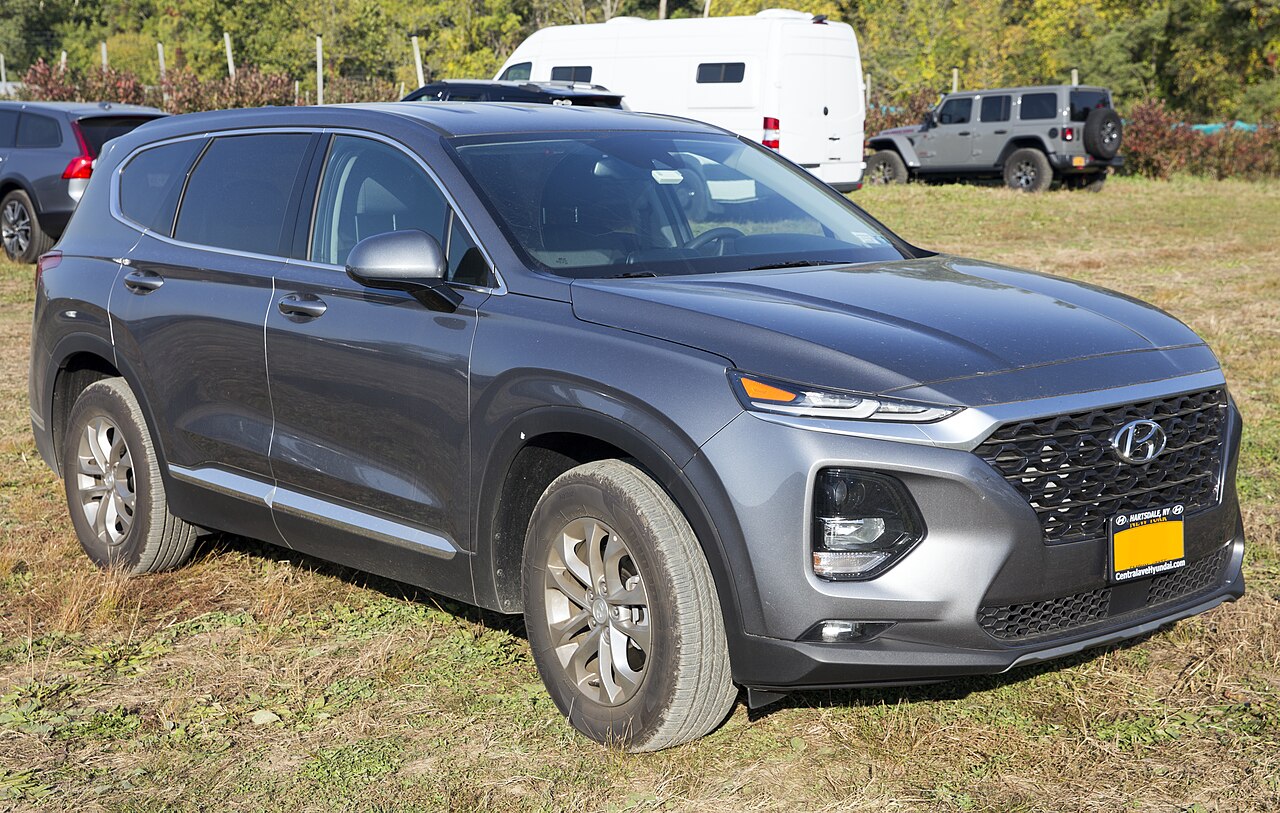
Hyundai Santa FE 2020

Car

Hyundai Santa FE 2020

12 source-linked failure reports. Most reported: Electrical system failure. Typical failure around 5.5 yr.

Reliability signal A · Early signal · data confidence Low

12 confirmed failure reports

Reliability summary

What is likely to go wrong, when it happens, and how expensive it can be — from source-linked failure reports. Counts are reports in our database, not a population failure rate.

Reliability signal

A

12 confirmed failure reports · Early signal · Data confidence: Low

Most common issue
Electrical system failure
Typical first failure
5.5 yr
Median of confirmed reports with timing
Median repair cost
—
Reported costs only · market varies
Highest reported repair
—
Not a quote · costs differ by country

What breaks?

Failure types

Click a type in the reports section below to filter.

  • Electrical system failure4 · 33.3%
  • Engine failure4 · 33.3%
  • Other2 · 16.7%
  • Structure / body failure1 · 8.3%
  • Fuel system failure1 · 8.3%

When does it break?

Failure timing

Months after purchase, using reports that included timing.

What does it cost?

Reported repair costs

Distribution of owner-reported repair costs— not a quote or guarantee. Labor and parts prices vary by country.

No reported repair costs yet for this model.

Median months to failure

66

Failure reports

12

View →

Median repair cost

—

Still recommend

—

% repaired

—

% mfr warranty

—

% extended warranty

—

% support helpful

—

Use these reports as a risk signal, then check current listings before you buy.

Search this model on Amazon

As an Amazon Associate, After Warranty may earn from qualifying purchases.

What breaks?

What breaks? · reports

Electrical system failure

ELECTRICAL SYSTEM,SERVICE BRAKES,ENGINE

35 months

Government / agencyIndexed Oct 9, 2026Source-linkedVerify source — NHTSA complaint #11522585

On Thursday, May 11, 11:45 am, I experienced a distressing incident at Moulton Elementary School in Laguna Niguel, CA, 92677. my car was parked near the school building, with the engine turned off and the gear set to park. I was there to pick up my children, and at that time, nobody was inside the vehicle. Unexpectedly, my car started moving backward as if in neutral gear, despite being in park mode. I estimate I was approximately 10 feet from the vehicle in front of the school building. The situation was alarming because numerous children were nearby, which could have resulted in a tragedy. Thankfully, no one was injured or hit by the moving vehicle. Instinctively, I attempted to stop the car by using my entire body to push against it. Unfortunately, my efforts were unsuccessful, and as a result, I sustained severe back pain. I have been on bed rest for the past five days due to the discomfort caused by the incident. Subsequently, the vehicle collided with another car, which belonged to a teacher. The incident shocked everyone, and the reason behind the car's unexpected movement remains unclear. Later, I discovered through online research that my car was actually on the recall list, but I had not been informed of this beforehand. As a result of the incident, we contacted the police, and they arrived at the scene can confirm that the car was indeed in park gear during the incident. It is vital to investigate this matter thoroughly to determine the cause of the vehicle's accidental movement and prevent future accidents. I hope that this statement provides a clear account of the accident that occurred at Moulton Elementary School. I strongly urge authorities and the involved parties to take immediate action to address the issues surrounding my car's movement and prevent any similar incidents from happening again.

VerifiedEvidence ★★★★☆
View report details

Months until failure

35 months

Repair cost

Not stated

Repaired

Not stated

Manufacturer warranty

Not stated

Extended warranty

Not stated

Support helpful

Not stated

Would recommend

Not stated

AI extraction confidence

90%

Verification status

Verified

Evidence quality

★★★★☆ (4/5)

Discussion

Engine failure

ENGINE

66 months

Government / agencyIndexed Oct 9, 2026Source-linkedVerify source — NHTSA complaint #11760193

2020 Hyundai Santa Fe SEL with 2.4L theta ii engine experiences severe oil consumption and repeated engine stalling during normal operation. The vehicle has a documented history of repeated low-oil conditions despite regular oil service. The problem progressed to the engine repeatedly stalling when returning to idle. When braking to a stop or while stopped at a traffic light or stop sign, the engine May stall unless the driver maintains additional throttle. This creates a safety concern because the engine can shut off during normal traffic operation. The vehicle was presented to centereach Hyundai for diagnosis. According to the Hyundai service advisor, the dealership found the engine with very little/nearly no engine oil despite the vehicle having traveled less than approximately 500 miles since its most recent oil service/top-off. The Hyundai technician reportedly suspects that the engine timing May have jumped and that this condition May be related to the low-oil condition and May explain the engine stalling. Hyundai has directed that an oil-consumption test be performed. The initial oil service/engine-flush procedure has been authorized by the owner at approximately $400. The procedure then contemplates approximately 1,000 miles of additional vehicle operation to measure oil consumption. This creates an additional safety concern because the vehicle being required to accumulate approximately 1,000 miles is the same vehicle that has been reported to repeatedly stall at idle and for which the Hyundai technician reportedly suspects a timing problem. The owner has requested that Hyundai document whether the vehicle has been evaluated for the stalling condition and whether Hyundai considers it appropriate to operate for the required mileage-accumulation test. Hyundai motor America case number: 43164946. VIN: 5NMS3CAD4LH173916.

VerifiedEvidence ★★★★☆
View report details

Months until failure

66 months

Repair cost

Not stated

Repaired

Not stated

Manufacturer warranty

Not stated

Extended warranty

Not stated

Support helpful

Not stated

Would recommend

Not stated

AI extraction confidence

90%

Verification status

Verified

Evidence quality

★★★★☆ (4/5)

Discussion

Other

UNKNOWN OR OTHER

73 months

Government / agencyIndexed Oct 9, 2026Source-linkedVerify source — NHTSA complaint #11766135

At approximately 42,000 miles, the AC system on my 2020 Hyundai Santa Fe suffered a potential immediate and premature failure, creating a severe driving safety hazard. The AC expansion valve began actively leaking refrigerant inside the dashboard, rendering the climate control system completely inoperable of normal operation. In Florida's high humidity and heavy rainstorms, this loss of proper AC function means the windshield defogging/defrosting mechanism fails to dehumidify cabin air. This results in sudden, severe window fogging while driving, heavily obstructing visibility and creating an imminent crash risk. Furthermore, as a senior managing multiple health conditions, a gradual, then total loss of cooling in extreme Florida heat poses a direct medical and physical safety hazard. The independent repair facility that fixed our vehicle noted an alarming pattern, servicing about 6 newer Hyundai models from our car's age group for similar AC failures and expansion valve leaks within a single month. Because an expansion valve is designed to last the life of a vehicle, this failure at 42,000 miles—combined with active industry investigations into internal Hyundai compressor degradation shedding debris downstream in the AC system—strongly indicates a systematic material defect. We have spent about $2,800 out-of-pocket to recharge the system, add dye, lose the charge again, and ultimately replace the valve inside the dashboard. Unfortunately, because Hyundai refuses to check our vehicle at their expense to find and remove potential Teflon or metal filings caused by this widespread compressor issue, and if needed, replace the compressor and other compromised components, this internal degradation can continue to cause recurring component leaks and damage at our unaffordable expense, while continuously releasing refrigerant into the air.

VerifiedEvidence ★★★★☆
View report details

Months until failure

73 months

Repair cost

Not stated

Repaired

Not stated

Manufacturer warranty

Not stated

Extended warranty

Not stated

Support helpful

Not stated

Would recommend

Not stated

AI extraction confidence

90%

Verification status

Verified

Evidence quality

★★★★☆ (4/5)

Discussion

Structure / body failure

STRUCTURE

62 months

Government / agencyIndexed Oct 9, 2026Source-linkedVerify source — NHTSA complaint #11718307

The roof of my car between the sunroof and the windshield (called panoramic sunroof) shattered as I was driving down the highway. It was about 10:00 pm on a weeknight and there were no cars within sight distance in front of me. When it happened it sounded like a gun shot going off at point blank range and I immediately pulled over and checked for bullet holes. Since it was dark I could not see any damage. Today I took the car and had a small chip fixed in my windshield down by the windshield wipers and the service tech pointed out to me that the roof was shattered. He told me that this happens a lot with this vehicle. So I got online and searched and found a lot of vehicles have reported the exact problem. Down to the sounds of gunshots. So I stopped at my local Hyundai dealership and recorded the conversation. He told me that theres no recalls on this car and It probably shattered by a rock or debris. I told him that when this happened it was late night and no cars within sight in front of me. He didn’t even come out and look at the damage. He said to call my insurance company and I said that is a manufacturer defect and I shouldn’t have to pay for their mistake. When I searched for this on the internet people stated that the dealerships will deny this manufacturer defect and that’s exactly what they said to me. My main concern is that this defect is documented by many vehicle owners from their 2020 vehicles and their Is a recall out for this problem but it stops at 2016 models. In this recall the shattered piece is replaced and there is actually compensation given for people getting scared or dealing with stress dealing with thinking they are getting shot at. I don’t care about any of that. I just want the issue fixed because I did not cause the issue, the manufacturer did. Reason being is that the exact thing is happening to numerous people across the Country. Thank you for your time.

VerifiedEvidence ★★★★☆
View report details

Months until failure

62 months

Repair cost

Not stated

Repaired

Not stated

Manufacturer warranty

Not stated

Extended warranty

Not stated

Support helpful

Not stated

Would recommend

Not stated

AI extraction confidence

90%

Verification status

Verified

Evidence quality

★★★★☆ (4/5)

Discussion

Engine failure

ENGINE

68 months

Government / agencyIndexed Oct 9, 2026Source-linkedVerify source — NHTSA complaint #11731527

Around Feb 15, 2026, at ~85,000 miles, the oil pressure warning light began illuminating at idle and extinguishing above idle speed. The vehicle had also been experiencing intermittent hard starts and occasional shuddering at idle — symptoms too subtle for a typical owner to connect to imminent engine failure. An independent mechanic performed a manual oil pressure test: 4 PSI (Hyundai minimum spec is 13 PSI). The authorized dealer confirmed 6 PSI and found metal shavings in the oil pan — the signature of connecting rod bearing wear documented in Theta II GDI engine failures. Dealer recommended full engine replacement ($8,500). Vehicle has been inoperable at the dealer since Feb 19, 2026. SAFETY CONCERN: At 4 PSI with metal debris in the oil system, this engine was at imminent risk of catastrophic seizure. I avoided highway driving after the warning appeared (max 50 mph, city streets only). Had the engine seized at highway speed, loss of power steering and brake vacuum assist would have created serious crash risk. The symptom profile — warning only at idle, clearing at speed, no knocking, no check engine light — is the pattern that puts less-vigilant drivers at risk of seizure at highway speed with no warning. KNOWN DEFECT: The 2.4L G4KJ Theta II GDI is identical to the engine subject to a $210M NHTSA civil penalty (2020), multiple recalls, and a ~$1.3B class action settlement extending lifetime warranties through MY 2019. The 2020 uses the same engine but was excluded. My failure mode is textbook Theta II. Hyundai Service Campaign 9C2 (ECU update for 2019-2020 Theta II, issued Nov 2025) was incomplete on this vehicle — I was never notified. Completed after the engine had already failed. Manufacturer denied coverage (Case #XXX). BBB AUTO LINE claim #XXX filed Apr 16, 2026. No crash. No injuries. No fire. INFORMATION REDACTED PURSUANT TO THE FREEDOM OF INFORMATION ACT (FOIA), 5 U.S.C. 552(B)(6)

VerifiedEvidence ★★★★☆
View report details

Months until failure

68 months

Repair cost

Not stated

Repaired

Not stated

Manufacturer warranty

Not stated

Extended warranty

Not stated

Support helpful

Not stated

Would recommend

Not stated

AI extraction confidence

90%

Verification status

Verified

Evidence quality

★★★★☆ (4/5)

Discussion

Electrical system failure

STEERING,ELECTRICAL SYSTEM,LANE DEPARTURE

72 months

Government / agencyIndexed Oct 9, 2026Source-linkedVerify source — NHTSA complaint #11743968

Vehicle experiences severe, intermittent, un-commanded steering inputs from the Lane Keeping Assist (LKA) system at highway speeds (55-70 MPH). The steering wheel violently jerks toward adjacent traffic lanes/shoulders without operator input, lane drift, or warning, requiring immediate high-force manual intervention to overpower mechanical torque and prevent a collision or roadway departure. Chronology of manufacturer notice: - Oct 2024: Initial consumer dispute logs flagged steering safety concerns and unresolved campaign items. - Dec 2024: Opened Corporate Case 24164934, formally alerting consumer affairs to dangerous steering wheel jerking. - Jan 2025: Presented to an authorized dealer; an OTA software update was deployed, but intermittent tracking failures persisted, including failure to recognize lanes at night. - June 2026: Under Case 42680760, the system failed acutely on the interstate, jerking the vehicle out of painted lanes. The malfunction originates in the LKA steering control module and camera hardware, which are intact and available for inspection. Dealerships have not replicated the defect during brief diagnostic windows due to its intermittent nature. The manufacturer has deflected these notifications and refused a forensic diagnostic sweep or mechanical remediation. Instead, case managers attempted to close the file by offering partial financial goodwill for an unrelated cosmetic paint delamination defect on the same vehicle. No warning lamps or error messages precede these events; the system executes aggressive mechanical intervention with zero notice. This system error bypasses driver override thresholds, conflicting with vehicle crash avoidance frameworks. Because the computer fails to log diagnostic trouble codes (DTCs) during these steering drops, the manufacturer exploits this data vacuum to deny structural remediation, creating severe multi-vehicle side-impact and rollover risks.

VerifiedEvidence ★★★★☆
View report details

Months until failure

72 months

Repair cost

Not stated

Repaired

Not stated

Manufacturer warranty

Not stated

Extended warranty

Not stated

Support helpful

Not stated

Would recommend

Not stated

AI extraction confidence

90%

Verification status

Verified

Evidence quality

★★★★☆ (4/5)

Discussion

Fuel system failure

FUEL/PROPULSION SYSTEM

70 months

Government / agencyIndexed Oct 9, 2026Source-linkedVerify source — NHTSA complaint #11739708

I took my vehicle in to the dealership on April 24, 2026 for a software update after receiving notice in the mail. The update changed my auto stop/start so that it is on whenever the vehicle is started. When removing my foot from the brake the car surges forward without me touching the gas peddle. I took my Hyandai back in to the dealership on May 4, 2026, and was told that the auto stop/start was supposed to now be staying on as that was in the software update. They said they could not duplicate the surging of the vehicle. It has surged strong enough to move forward, while stopped at an intersection, that it put me out two to three feet. I felt it necessary to put it in reverse and back up it was out so far. This will absolutely put others at risk as I drive and work in a downtown area with lots of crosswalks with lots of people crossing, and should vehicles be stopped in front of me, it could hit them. I can turn it off, but in the beginning it seemed to be turning itself back on. Additionally, I am not used to always turning it off because I never had to before and I don't always remember. This week, something new: When pulling off after starting the car, even if I remember to turn off the start/stop, the car is jerking forward when I depress the gas. It's like it is getting surges of gas, or like the peddle is being pushed to the floor, let off, pushed to the floor, let off, etc. I am so incredibly scared now to just drive the vehicle I've loved for over five years now. My vehicle has not been inspected by the manufacturer, police, insurance or any others. I did not know this was an option. I would love to get more information about how to go about this. There are no warnings of any kind when this occurs, which is every single time I get in it. Please, someone, tell me what I can do further. Continue taking it back to the dealership? Ride with them next time? I just am at a loss and incredibly scared. I am a woman in my 60s.

VerifiedEvidence ★★★★☆
View report details

Months until failure

70 months

Repair cost

Not stated

Repaired

Not stated

Manufacturer warranty

Not stated

Extended warranty

Not stated

Support helpful

Not stated

Would recommend

Not stated

AI extraction confidence

90%

Verification status

Verified

Evidence quality

★★★★☆ (4/5)

Discussion

Other

UNKNOWN OR OTHER

66 months

Government / agencyIndexed Oct 9, 2026Source-linkedVerify source — NHTSA complaint #11717373

On the morning of December 10, 2025, I left my home for an appointment. I traveled for about 15 minutes before entering onto the highway. As I entered the highway, I traveled about half a mile and was scared by a very loud explosion! I pulled over to assess my vehicle and the surrounding area. The sunroof had SHATTERED to pieces, fortunately I didn’t have it open at the time. It was just a miracle I didn’t have an accident from being startled, or receive any cuts or injuries due to this unforeseen event. As I was driving, there was very little to no traffic and I never heard anything like hit the car or window or anything. I called my insurance company and filed a claim. They eventually had me to take it to a Collision Center 12/22/2025. They removed all glass from sunroof, and determined that there was an issue with the glass rack, and it would end up being very costly. My Insurance Provider contacted me to say they would not be able to provide coverage due to the cost and findings of the Collision Center. So they backed out and informed me that I needed to file a claim with Hyundai. So I picked the vehicle up 1/19/2026 from the Collision Center. Then I filed a claim with Hyundai, and was told to schedule an appointment for inspection. I took the vehicle for inspection 1/22/2026, after about a week I was told that the vehicle had been inspected there was nothing they could do. I’m confused as to how the inspection went since there was no glass present in order to check the opening and closing of the car rack. Plus the plastic that the Collision Center placed on it was barely removed. So I picked the vehicle up 1/30/2026. and it’s been sitting in my driveway covered every since. The vehicle has been inspected by a Collision Center, and the Dealership without any success. There were no warning lights of any indication of trouble on the dashboard at any given time, not even when the explosion occurred. The vehicle is available for inspection upon request. Thank you

VerifiedEvidence ★★★★☆
View report details

Months until failure

66 months

Repair cost

Not stated

Repaired

Not stated

Manufacturer warranty

Not stated

Extended warranty

Not stated

Support helpful

Not stated

Would recommend

Not stated

AI extraction confidence

90%

Verification status

Verified

Evidence quality

★★★★☆ (4/5)

Discussion

Engine failure

UNKNOWN OR OTHER,ENGINE

60 months

Government / agencyIndexed Oct 9, 2026Source-linkedVerify source — NHTSA complaint #11666402

June 2020 I purchased the car brand new 2020 Hyundai Santa Fe SE 2.5L from dealership, after the first year I started having issues with my display monitor just shutting off and my car going idle at red lights or when I’m sitting in traffic. I’ve never been in an accident and I’m not a reckless driver to my standards besides occasional potholes, the car going idle happened 3 times before I reached out to a dealership asking questions only for them to tell me, “it sounds like I’m using the start-Stop feature too much and it’s not recommended to be used often”. So I stopped using it completely. Fast forward throughout the years, it still happened about 5-10 times a year for the past few years, I’ve learned to hurry up and put it in park, give it gas, then put it in drive. Fast forward 2025, Feb I was passed due for an oil change about 300-500 miles the the oil light came on and when I check it myself the oil tank was completely empty, I assumed it was normal since I was passed due for an oil change, and a family friend told me that wasn’t normal, I follow the recommended oil change interval on my warranty paperwork 7,500 even set my car to it, after the oil change my car was fine. I took it in at 130,284 miles, fast forward June 2025, I start my car a morning for work & it’s at 135,658 miles, the oil light comes back on and I notice it’s completely empty again. 2nd time it’s happened this year, and two family friends that are licensed mechanics tell me that’s not normal especially if I’ve gotten an oil change this year & it’s seems like the engine is burning oil too quick. I took it in to get another oil change, tell them about the issue of it being empty when I’ve been this year and it doesn’t seem right, the dealership & a local quick oil change place tells me it’s due to me not bringing it in for regular maintenance. There are no lights on on my dashboard, and when I called the dealership to ask about using the lifetime powertrain warranty I have, I have to pay.

VerifiedEvidence ★★★★☆
View report details

Months until failure

60 months

Repair cost

Not stated

Repaired

Not stated

Manufacturer warranty

Not stated

Extended warranty

Not stated

Support helpful

Not stated

Would recommend

Not stated

AI extraction confidence

90%

Verification status

Verified

Evidence quality

★★★★☆ (4/5)

Discussion

Electrical system failure

ELECTRICAL SYSTEM,LANE DEPARTURE,FORWARD COLLISION AVOIDANCE

61 months

Government / agencyIndexed Oct 9, 2026Source-linkedVerify source — NHTSA complaint #11676563

*Problem Parts:I only could check 1 box- should be Brakes and Steering too *ADAS: Lane Keeping Assistance too Over the course of two days, my 2020 Hyundai Santa Fe experienced a serious electrical and safety system failure. It started with the blind spot monitoring lights flickering in the side mirrors and warnings for Forward Collision Avoidance (disabled), ABS, Electronic Stability Control, Downhill Brake Control, Parking Brake & Brake Fluid (blinking red). The rearview camera failed and the screen remained on the radio display when in reverse. The Lane Keeping Assist Indicator shifted from white/green to orange. The next morning, I had trouble opening the vehicle with the key fob. Auto Hold, Master Warning, Forward Collision, ESC, and Downhill Brake Control lights were now steadily on. The MPH numbers on the dash were blurred, and a message appeared saying “Put in P” even though the vehicle was already parked. The accessories light came on, but the engine would not start. Interior lights continued to work. I had to manually open the car and start it by pressing the fob to the button. While trying to exit a parking garage (where a tow truck couldn’t reach me), more warnings appeared: AWD, Low Tire Pressure, Malfunction Indicator (not engine), and Power Steering. I felt tightness in the wheel and had to pull over. The temp and gas gauges dropped to zero along with the RPMs. I have a newer car battery and recently replaced fob batteries, so this was not a simple battery failure. I’ve reported the issue to Hyundai Consumer Affairs. No recall appears under my VIN, despite similar failures being widely reported in this model. I’m a single parent who typically drives with two young children, including one with serious medical needs. I rely heavily on this vehicle for medical travel. The vehicle has since been towed to a Hyundai dealership for diagnostics. This is a serious safety concern and could have led to a loss of control or failure in an emergency situation

VerifiedEvidence ★★★★☆
View report details

Months until failure

61 months

Repair cost

Not stated

Repaired

Not stated

Manufacturer warranty

Not stated

Extended warranty

Not stated

Support helpful

Not stated

Would recommend

Not stated

AI extraction confidence

90%

Verification status

Verified

Evidence quality

★★★★☆ (4/5)

Discussion

Engine failure

POWER TRAIN,ENGINE,BACK OVER PREVENTION

73 months

Government / agencyIndexed Oct 9, 2026Source-linkedVerify source — NHTSA complaint #11761774

Hyundai Motor America & Wallace Hyundai of StuartVEHICLE: 2020 Hyundai Santa Fe (2.4L Theta II GDI Engine)VIN: 5NMS23AD5LH181669INCIDENT MILEAGE: 181,000 MiHYUNDAI CASE NUMBER: 42981944SECTION 1: CATASTROPHIC INTERSTATE SAFETY INCIDENTOn July 16, 2026, while navigating heavy, high-speed traffic on Interstate 95 (I-95) at approximately 80 to 85 MPH, my vehicle suffered an un-commanded, catastrophic mechanical engine seizure. The vehicle instantly dropped from highway speeds down to a 21 MPH "limp mode," creating an immediate multi-car pile-up hazard on a major interstate. Physical inspection immediately after the failure proved that the engine oil level was completely full. The internal components catastrophically failed due to a documented, systemic factory defect involving premature rod bearing failure and oil starvation mechanisms, entirely unrelated to consumer maintenance.SECTION 2: PRIOR SAFETY COMPLAINTS & DOCUMENTED TIMELINEHyundai Motor America has intentionally forced me to operate a known, life-threatening safety hazard for 17 months, during which I drove an additional 31,000 miles under extreme duress. I filed formal oil consumption complaints with Hyundai Corporate every three to four months. I was forced to manually replenish the engine oil every 1,000 miles due to excessive oil loss.Specific safety reports detailing hazardous engine behavior were formally logged with Hyundai on November 25, 2025, and again in April 2026. Rather than remediating the vehicle, Hyundai corporate claims adjusters and dealership supervisors ignored these warning tracks, effectively throwing a consumer out into active traffic in an unsafe, defective vehicle.SECTION 3: AUTOMATIC SHUTDOWN TRAUMA & ACCIDENT RISKThe manufacturing defects caused an intermittent, un-commanded automatic The manufacturing defects caused an intermittent, un-commanded automatic engine shutdown condition. On 5 to 10 separate occasions while stationary at active traffic lights, the vehicle stalled10times

VerifiedEvidence ★★★★☆
View report details

Months until failure

73 months

Repair cost

Not stated

Repaired

Not stated

Manufacturer warranty

Not stated

Extended warranty

Not stated

Support helpful

Not stated

Would recommend

Not stated

AI extraction confidence

90%

Verification status

Verified

Evidence quality

★★★★☆ (4/5)

Discussion

Electrical system failure

ELECTRICAL SYSTEM,ENGINE

45 months

Government / agencyIndexed Oct 9, 2026Source-linkedVerify source — NHTSA complaint #11592945

Prior to these occasions, the Hyundai Santa Fe was constantly needing oil added. On top of that, starting on [XXX], my 2020 Hyundai Santa Fe coded with a check engine light blinking in the upper right corner of the dashboard. I was on [XXX] in NW Indiana on my way to a meeting. The SUV would not accelerate past 2,000 rpm and bogged down on a national interstate sending me into a panic. I had my car towed back to my house. I called my brother in law, [XXX] , who sold me the vehicle in November 2020, to get advice on what to do next. I was told to have the vehicle towed to the nearest dealership. After having my car sit there for two weeks, Webb Hyundai finally looked at it. They upgraded the knock sensor software and had the knock sensor replaced. With the plethora of things that I asked to be repaired or looked at, they only fixed the knock sensor. Due to an extended warranty, I paid $100. Two days later, the SUV got a flat tire. The SUV sat for a week or week and a half due to a flat tire and the place not having it in stock. [XXX] driving back from getting my new tire put on in Valparaiso, Indiana, the vehicle coded again on [XXX]. It caused another very dangerous situation as the vehicle slows to 2,000 rpms. Once again, I had the SUV towed back to my home in Cedar Lake, Indiana. It sat for a few days while I was deciding my next move. This time, I had the vehicle towed to Gerald Hyundai, where my brother in law works and where the vehicle was originally purchased. The vehicle arrived [XXX], 2024. The SUV only sat for one day before telling me all the work that needed to be done. Some of the charges were covered by the extended warranty. Total bill was $540. The work was done on May 13, 2024. I could not pick up the vehicle until the weekend. However, my other car was in an accident, so I did not make it until [XXX] 2024. Shortly after picking up my vehicle, the SUV coded again on [XXX] going back to Indiana. More to follow.. INFORMATION REDACTED PURSUANT TO THE F

VerifiedEvidence ★★★★☆
View report details

Months until failure

45 months

Repair cost

Not stated

Repaired

Not stated

Manufacturer warranty

Not stated

Extended warranty

Not stated

Support helpful

Not stated

Would recommend

Not stated

AI extraction confidence

90%

Verification status

Verified

Evidence quality

★★★★☆ (4/5)

Discussion

Compare nearby models

Similar products

Stay ahead of failures

Notify me about this model

Get an email when a new source-linked failure report is published for the Hyundai Santa FE 2020.

We only email when a new published report is added for Hyundai Santa FE 2020. No spam, unsubscribe by contacting support.

Contribute signal

Had a failure with this model?

Add your experience and help future shoppers understand what happens after the warranty.

Submit your experience